
News
How to correct choose scoop coater and squeegee size in the screen printing?
Core Principle: First, match the screen mesh count and ink characteristics, then select the scoop coater and squeegee size, balancing coating uniformity, ink layer thickness, and durability to suit different printing scenarios.
I. Key Points for Selecting a scoop coater
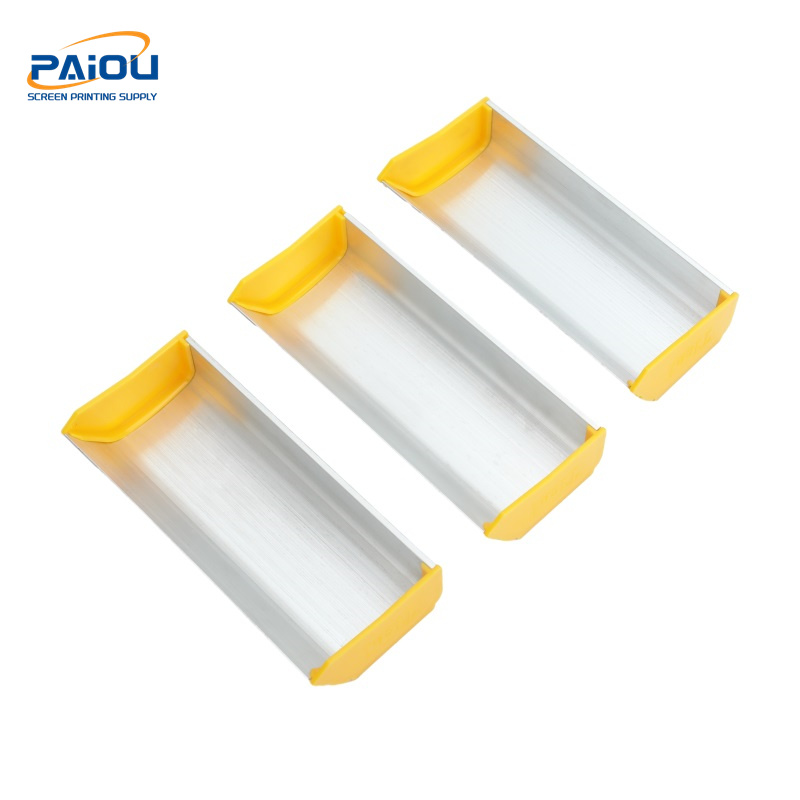
The core function of the scoop coater is to evenly coat the screen with photosensitive emulsion. Selection depends on four factors: screen width, mesh count, required ink layer thickness, and material.
1. Core Specification Selection
- Length Selection: The effective length of the scoop coater= screen printing area width + 5~10cm, avoiding ink leakage at both ends and incomplete coating; for example, if the printing area is 30cm wide, select a 35~40cm scoop coater.
- Groove Height (Determines Adhesive Layer Thickness): The higher the groove, the thicker the adhesive layer per application, suitable for different mesh counts:
Low mesh count (15~100 mesh, thick/coarse-grained pastes, such as inks, conductive pastes): Select a 1.5~3mm groove; a thicker adhesive layer ensures sufficient ink filling.
Medium to high mesh count (120~300 mesh, general graphic printing): Select a 0.8~1.5mm groove to balance adhesive layer uniformity and ink permeability.
High mesh count (350~420 mesh, fine graphics/thin ink printing, such as PET film printing, precision patterns): Select a 0.3~0.8mm groove; a thinner adhesive layer avoids screen clogging and ensures sharp lines.
2. Material Selection
- Stainless Steel scoop coater: First Choice! Corrosion resistant, not easily deformed, smooth surface, compatible with all water-based/oil-based photosensitive adhesives, long service life, universally applicable in industrial production;
- Plastic (PP/ABS) scoop coater: Low price, lightweight, suitable for prototyping/small batch production, avoid using strong solvent-based photosensitive adhesives as they are easily corroded and deformed;
- Aluminum alloy scoop coater: High cost-performance ratio, medium hardness, suitable for conventional low to medium mesh count screens, avoid prolonged contact with strong acid and alkali photosensitive adhesives.
II. Key Considerations for Squeegee size
The squeegee determines printing pressure, ink transfer volume, solvent resistance, and lifespan. Selection should focus on four core factors: hardness, material, cross-sectional shape, and size, matching the printing scenario and ink type.
1. Core Point: Hardness
Higher hardness results in a harder squeegee, cleaner ink transfer, and sharper lines, but less ink filling; lower hardness results in a softer squeegee, more ink filling, and suitability for curved surfaces, but is prone to deformation and has poor detail.
- Low Hardness (60~75A): Soft, suitable for curved surface printing, thick ink printing, and rough substrates (such as fabric, cardboard), high ink filling, and less likely to scratch the substrate;
- Medium Hardness (75~85A): General purpose! Suitable for conventional flatbed printing and most inks/pastes (water-based inks, solvent-based inks, ordinary conductive pastes), balancing ink coverage and printing precision; the first choice for 90% of applications.
- High hardness (85~95A): Rigid material, suitable for fine graphics, high mesh count screens, and thin ink printing (such as PET film, electronic components, precision logos), ensuring clean squeegee work, clear lines, and resistance to deformation.
2. Material Selection (Solvent-resistant + Abrasion resistant + Ink-compatible)
- Polyurethane (PU) squeegee: The first choice for industrial applications! - Wear-resistant, resistant to most solvents (water-based/oil-based inks, thinners), highly elastic, long lifespan, suitable for almost all screen printing scenarios, offering the best cost-performance ratio.
3. Cross-sectional Shape Selection
Square Squeegee: Most commonly used! - Flat on both sides, wear-resistant, with uniform pressure, suitable for conventional flat printing and mass production, highly durable;
Pointed (triangular) squeegee: Small contact area, concentrated pressure, suitable for fine lines, small characters, and high mesh count screens, offering the highest printing precision, but with slightly lower wear resistance;
Angled squeegee: One side is angled, suitable for thick ink printing and scenarios requiring large ink filling, suitable for low mesh count screens.
4. Size Selection
Width: Effective squeegee width = screen printing area width + 3~5cm, to avoid missing prints at both ends, and to match the length of the coating applicator;
Thickness: 5~10mm is the standard selection. Thin squeegee (3~5mm) is suitable for fine printing, while thick squeegee (10~15mm) is suitable for thick paste/high pressure printing.
Welcome to contact PAIOU team for professional support and advice.
I. Key Points for Selecting a scoop coater
The core function of the scoop coater is to evenly coat the screen with photosensitive emulsion. Selection depends on four factors: screen width, mesh count, required ink layer thickness, and material.
1. Core Specification Selection
- Length Selection: The effective length of the scoop coater= screen printing area width + 5~10cm, avoiding ink leakage at both ends and incomplete coating; for example, if the printing area is 30cm wide, select a 35~40cm scoop coater.
- Groove Height (Determines Adhesive Layer Thickness): The higher the groove, the thicker the adhesive layer per application, suitable for different mesh counts:
Low mesh count (15~100 mesh, thick/coarse-grained pastes, such as inks, conductive pastes): Select a 1.5~3mm groove; a thicker adhesive layer ensures sufficient ink filling.
Medium to high mesh count (120~300 mesh, general graphic printing): Select a 0.8~1.5mm groove to balance adhesive layer uniformity and ink permeability.
High mesh count (350~420 mesh, fine graphics/thin ink printing, such as PET film printing, precision patterns): Select a 0.3~0.8mm groove; a thinner adhesive layer avoids screen clogging and ensures sharp lines.
2. Material Selection
- Stainless Steel scoop coater: First Choice! Corrosion resistant, not easily deformed, smooth surface, compatible with all water-based/oil-based photosensitive adhesives, long service life, universally applicable in industrial production;
- Plastic (PP/ABS) scoop coater: Low price, lightweight, suitable for prototyping/small batch production, avoid using strong solvent-based photosensitive adhesives as they are easily corroded and deformed;
- Aluminum alloy scoop coater: High cost-performance ratio, medium hardness, suitable for conventional low to medium mesh count screens, avoid prolonged contact with strong acid and alkali photosensitive adhesives.
II. Key Considerations for Squeegee size
The squeegee determines printing pressure, ink transfer volume, solvent resistance, and lifespan. Selection should focus on four core factors: hardness, material, cross-sectional shape, and size, matching the printing scenario and ink type.
1. Core Point: Hardness
Higher hardness results in a harder squeegee, cleaner ink transfer, and sharper lines, but less ink filling; lower hardness results in a softer squeegee, more ink filling, and suitability for curved surfaces, but is prone to deformation and has poor detail.
- Low Hardness (60~75A): Soft, suitable for curved surface printing, thick ink printing, and rough substrates (such as fabric, cardboard), high ink filling, and less likely to scratch the substrate;
- Medium Hardness (75~85A): General purpose! Suitable for conventional flatbed printing and most inks/pastes (water-based inks, solvent-based inks, ordinary conductive pastes), balancing ink coverage and printing precision; the first choice for 90% of applications.
- High hardness (85~95A): Rigid material, suitable for fine graphics, high mesh count screens, and thin ink printing (such as PET film, electronic components, precision logos), ensuring clean squeegee work, clear lines, and resistance to deformation.
2. Material Selection (Solvent-resistant + Abrasion resistant + Ink-compatible)
- Polyurethane (PU) squeegee: The first choice for industrial applications! - Wear-resistant, resistant to most solvents (water-based/oil-based inks, thinners), highly elastic, long lifespan, suitable for almost all screen printing scenarios, offering the best cost-performance ratio.
3. Cross-sectional Shape Selection
Square Squeegee: Most commonly used! - Flat on both sides, wear-resistant, with uniform pressure, suitable for conventional flat printing and mass production, highly durable;
Pointed (triangular) squeegee: Small contact area, concentrated pressure, suitable for fine lines, small characters, and high mesh count screens, offering the highest printing precision, but with slightly lower wear resistance;
Angled squeegee: One side is angled, suitable for thick ink printing and scenarios requiring large ink filling, suitable for low mesh count screens.
4. Size Selection
Width: Effective squeegee width = screen printing area width + 3~5cm, to avoid missing prints at both ends, and to match the length of the coating applicator;
Thickness: 5~10mm is the standard selection. Thin squeegee (3~5mm) is suitable for fine printing, while thick squeegee (10~15mm) is suitable for thick paste/high pressure printing.
Welcome to contact PAIOU team for professional support and advice.

Leave a Comment